




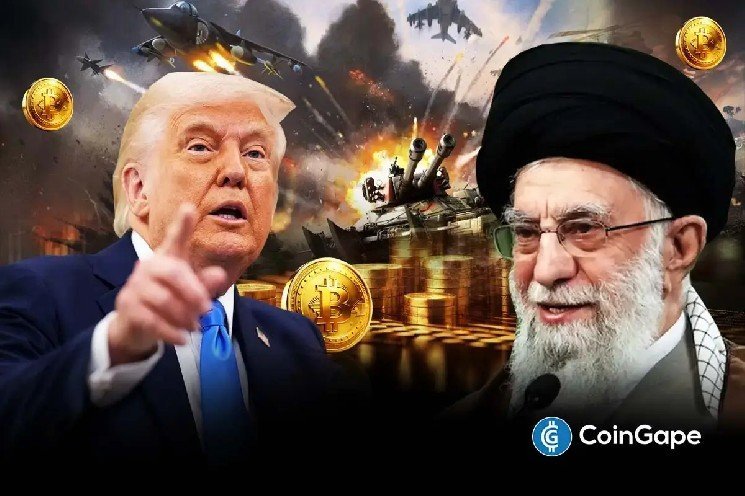
Alright, folks, buckle up! The global financial markets are highkey buzzing right now, and it’s not just your usual Tuesday afternoon chatter. Former President Donald Trump’s recent, straight-up warning to Iran, just ahead of crucial nuclear talks, has sent ripples through everything from oil futures to your favorite digital assets. The big question on everyone’s mind, no cap, is whether this geopolitical tension will send safe-haven assets like gold soaring or put the brakes on the crypto rocket, especially Bitcoin. This latest Iran warning is more than just political theater; it’s a legit market mover, potentially shaping portfolios for savvy investors and everyday folks alike.
Historically, when the world gets a bit sketchy and geopolitical risks flare up, investors tend to flock to assets perceived as safe havens. Gold, the OG store of value, usually sees a boost. It’s been doing its thing for centuries, a true analog hedge against instability. But in this digital age, Bitcoin has emerged as a contender, often dubbed ‘digital gold.’ The narrative suggests it’s a decentralized asset, free from government control, and thus, a perfect hedge against inflation or geopolitical turmoil. However, its relatively nascent history means its correlation with traditional safe havens isn’t always on point. So, when Trump drops a warning like this, creating significant uncertainty around the future of international diplomacy and regional stability in the Middle East, both gold and Bitcoin find themselves under the microscope.
Let’s rewind a bit. Trump’s foreign policy approach, particularly concerning Iran, has always been pretty distinct. He pulled the U.S. out of the Joint Comprehensive Plan of Action (JCPOA), or the Iran nuclear deal, back in 2018, calling it ‘defective.’ His administration then reimposed stringent sanctions, aiming to cripple Iran’s economy and force a new, more comprehensive agreement. This latest warning, while coming from a former president, still carries weight given his continued influence in American politics and the potential implications for future U.S. foreign policy, especially if he runs again. These nuclear talks aren’t just some lowkey diplomatic meeting; they’re high-stakes negotiations that could either de-escalate tensions or ignite them further.
For gold bugs, this kind of news is often a siren call. Gold thrives on fear and uncertainty. A potential breakdown in talks, renewed hostilities, or an escalation of rhetoric could easily send gold prices climbing. Think of it as the ultimate financial bunker – when everything else feels shaky, folks park their capital in something tangible and universally recognized as valuable. Gold doesn’t care about interest rates in the same way stocks do, nor is it beholden to a specific government’s policies, making it a dope choice for hedging against political instability. The market generally reacts to the *possibility* of conflict even more sharply than the conflict itself, so these pre-talk warnings can be significant.
Now, let’s talk about Bitcoin. The ‘digital gold’ thesis has been tested multiple times. Sometimes, it acts like a risk-on asset, moving in lockstep with tech stocks. Other times, it behaves like a safe haven, particularly when traditional financial systems show cracks or inflation fears loom. In the context of a geopolitical showdown involving a major oil producer like Iran, the waters get a bit murky for Bitcoin. While its decentralization offers a hedge against currency debasement or government seizure, its volatility can be a double-edged sword. Is it mature enough to consistently serve as a safe harbor during a genuine international crisis? That’s the million-dollar question, and frankly, the jury is still out. We’ve seen instances where global uncertainty has both boosted Bitcoin as a hedge and caused it to tumble as investors shed riskier assets across the board.
The upcoming nuclear talks themselves are a complex dance. On one side, there’s the international community hoping to restore some semblance of the nuclear deal to prevent Iran from developing nuclear weapons. On the other, Iran is seeking sanctions relief and guarantees that any new agreement won’t be easily abandoned by future U.S. administrations. Trump’s recent comments inject a wild card into this already delicate situation, making both sides potentially more entrenched or, paradoxically, more eager to secure a deal to avoid further escalation. The outcome could range from a renewed, stable agreement to a complete collapse of negotiations, each scenario carrying vastly different implications for global markets.
Investors need to keep their heads up, for real. Beyond the immediate price fluctuations of Bitcoin and gold, these geopolitical developments have broader economic implications. Oil prices, for instance, are highly sensitive to Middle Eastern stability. Any disruption in oil supply or transit routes could send energy costs through the roof, leading to inflationary pressures globally. This, in turn, could influence central bank policies, interest rates, and ultimately, the performance of every asset class. It’s a domino effect, dude, and a major geopolitical event can truly be a catalyst for a global economic shift.
So, what’s the takeaway? The market’s reaction to Trump’s Iran warning and the unfolding nuclear talks is a critical test for both traditional and digital safe havens. Gold will likely continue its role as a bedrock asset during uncertainty, but Bitcoin’s journey to becoming a universally accepted safe haven is still evolving. Keep an eye on the headlines, stay diversified, and remember that in times of geopolitical flux, volatility is highkey the only guarantee. It’s a wild ride out there, and staying informed is your best defense against the market’s swings.
If you enjoyed this article, share it with your friends or leave us a comment!