




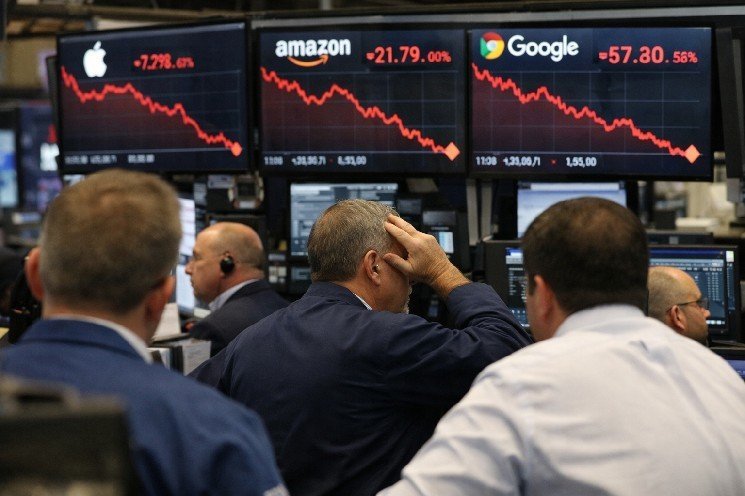
Alright, folks, buckle up because last week the S&P 500 decided to throw us a curveball. The market pulled back, erasing all its earlier gains for the year, even though corporate earnings were looking strong and the macro data was, dare I say, pretty solid. It’s like the market heard some good news and said, “Nah, not today, dude.” The index dipped to around $6,835 by Friday, a noticeable slide from its year-to-date high of $7,000. So, what’s the lowdown on why this happened, and what should we be keeping an eye on as we kick off a new week?
This kind of disconnect – where positive economic signals don’t translate into market gains – can feel a bit sketchy, no cap. Historically, it often signals that investors might be engaging in some profit-taking after a strong run, or maybe they’re just pausing to digest all the good news and reassess valuations. Sometimes, it’s a sign of underlying concerns that aren’t immediately visible, like geopolitical tensions or a quiet shift in sector preferences. Whatever the reason, this coming week is going to be crucial as we look to a fresh batch of earnings reports from some seriously big players, and get some more intel from the Federal Reserve.
Now, let’s talk about the data that should have sent the market soaring. Just last Wednesday, we got news that the U.S. economy added a respectable 130,000 jobs in January, with the unemployment rate ticking down to a tidy 4.3%. That’s a healthy labor market, plain and simple. Then, the cherry on top: the Consumer Price Index (CPI) cooled down to 2.4% in January. For those keeping score, that’s getting mighty close to the Fed’s coveted 2.0% inflation target. This kind of data usually has investors high-fiving, as it strongly hints at the possibility of more interest rate cuts from the Federal Reserve this year than initially anticipated. Cheaper money usually means a juiced-up economy, which is typically good for stocks, right?
On the corporate front, earnings season has been, for the most part, pretty fire. FactSet data shows that a whopping 74% of S&P 500 companies have already spilled the beans on their financial results, and the average earnings growth is clocking in at an impressive 13.2%. That’s legit performance across a broad swath of American businesses. But even with these strong fundamentals, the market decided to hit the brakes. It’s almost like Wall Street is saying, “We see the good numbers, but what’s next? What’s the catch?”
Adding another layer to the mix are political whispers. There’s talk that former President Trump, potentially eyeing a return to office, might be considering rolling back some steel and aluminum tariffs. This move, if it happens, would be a pretty significant concession, especially given his past stance on trade. In a world battling a persistent cost-of-living crisis, such a decision could potentially ease supply chain pressures and lower input costs for many American industries, which could, in turn, filter down to consumers. Keep an eye on this; it’s not just political drama, it could have real economic ripple effects.
This week, however, might be a bit muted in terms of overall market activity. First off, Monday is President’s Day, so the stock market will be closed for a well-deserved long weekend – a nice little break for traders to recharge. Plus, as we mentioned, most S&P 500 companies have already released their quarterly reports. That means the big, broad market-moving earnings are mostly behind us. But that doesn’t mean there’s nothing to watch. Far from it.
While the heavy hitters of earnings season have mostly wrapped up, we still have some major players whose reports could cause some serious waves in their respective sectors and even the broader market. We’re talking about companies like Medtronic, Palo Alto Networks, Analog Devices, Booking Holdings, Moody’s Corporation, Carvana, eBay, and Garmin. These aren’t small fry; their performance can give us a clearer picture of specific industry trends, from tech and cybersecurity to travel and consumer spending. Carvana and eBay, for instance, are key indicators of online retail health, which has been an interesting mixed bag lately.
But the one everyone will be watching this week, for real, is Walmart. The retail giant, whose market capitalization recently crossed the massive $1 trillion milestone, is a bellwether for American consumer health. When Walmart speaks, Main Street listens, because their sales growth reflects how everyday Americans are feeling about their finances and what they’re willing to spend. Their earnings report will be absolutely crucial for understanding the state of consumer confidence and spending habits in the current economic climate, especially with inflation still being a topic of discussion at dinner tables nationwide.
Beyond earnings, Uncle Sam is set to drop some minor but still important economic data bombs this week. Wednesday will be a busy day with reports on building permits and housing starts – key indicators for the health of the housing market, which has been a wild ride lately. On the same day, we’ll get durable goods orders and industrial production data, giving us insights into manufacturing and big-ticket item purchases. Then, on Friday, the updated U.S. GDP data for the fourth quarter will hit the wires. Economists are generally expecting a growth rate around 3%, which is a bit of a cool-down from the earlier estimate of 4.4%, but still a solid growth number.
Most importantly, the Federal Reserve will release the minutes from its last monetary policy meeting on Wednesday. These minutes are a treasure trove of information, providing a deeper dive into the committee’s discussions, their individual perspectives, and any nuances that might not have been obvious from the official statement. They often give us clues about the Fed’s future moves, including their appetite for interest rate cuts. With inflation showing clear signs of receding, many economists are betting on at least three rate cuts this year, so these minutes could confirm or deny that sentiment.
And if that wasn’t enough, we’ll also hear from several Federal Reserve officials throughout the week, including Raphael Bostic, Neel Kashkari, Michele Bowman, and Mary Daly. These speeches are always worth tuning into, as they offer individual perspectives and can sometimes provide a “heads up” on the direction of monetary policy. They’ll undoubtedly add more color to what we can expect from the Fed in the coming months, which is a big deal for the market, for real.
So, while the S&P 500’s recent dip might have some investors feeling a little antsy, this week is packed with enough economic and corporate news to potentially shift sentiment. Keep your eyes peeled on those earnings and the Fed’s signals; it’s going to be an interesting ride, no doubt. The market is always a puzzle, and this week’s pieces are about to drop.
If you enjoyed this article, share it with your friends or leave us a comment!
